
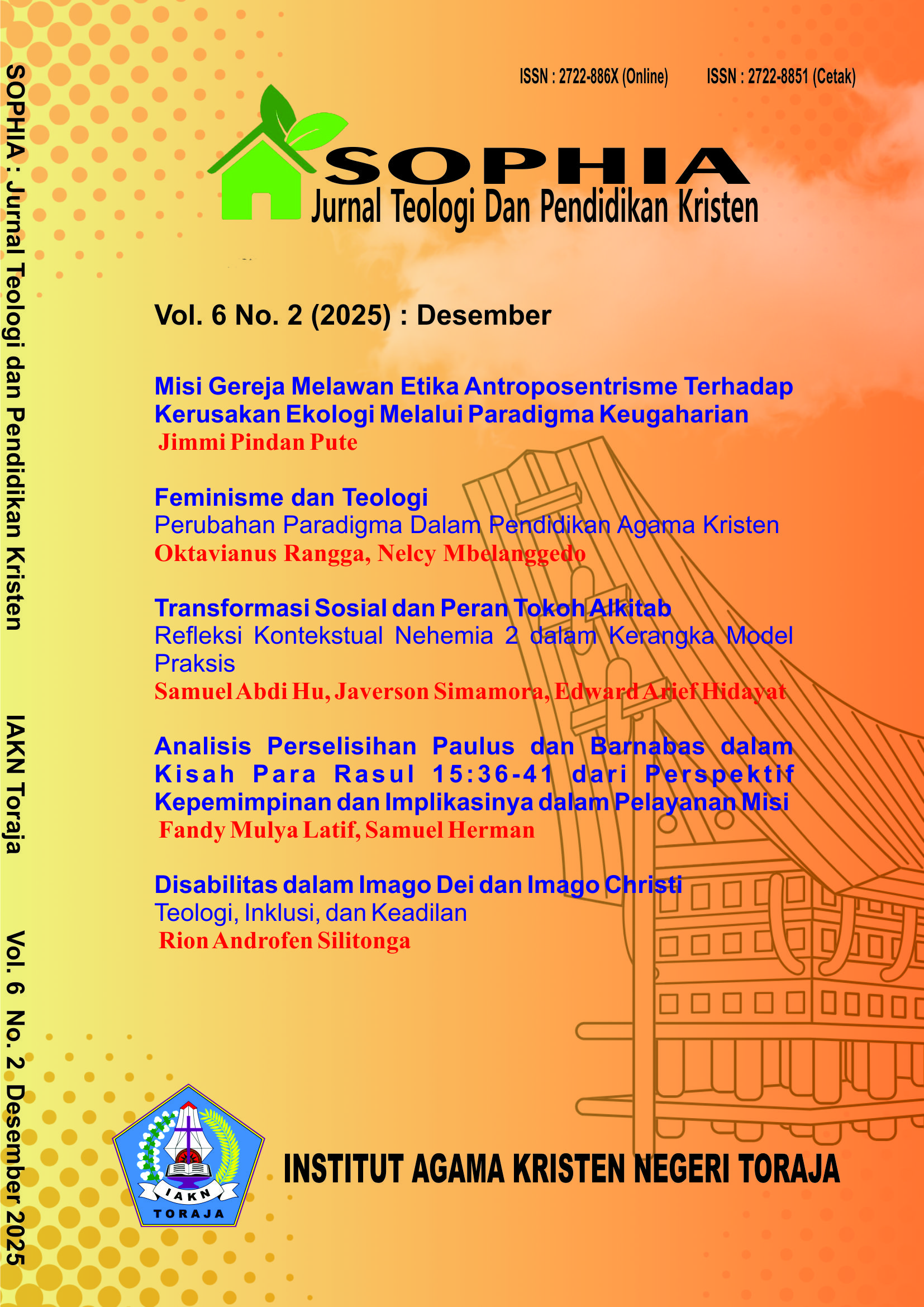
Disabilitas dalam Imago Dei dan Imago Christi Teologi, Inklusi, dan Keadilan
Article Sidebar
Main Article Content
Abstract
Disability is a complex phenomenon that involves various aspects of life, including physical, cognitive, and psychiatric. From a Christian theological perspective, disability is often viewed through a challenging lens, either as a test, a suffering, or a symbol of sin. However, this understanding often ignores the dignity and rights of people with disabilities as creatures made in the image of God (Imago Dei). Through theological thinking such as that promoted by Augustine and Jurgen Moltmann, disability can be understood as part of God's greater plan, which demands recognition, respect, and proper care. Inclusive theology, as reflected in 1 Corinthians 12, emphasizes the active role of every member of the body of Christ, including people with disabilities, in the community of faith. The social stigma of disability, both physical and mental, is a major obstacle to social inclusion, but through a deeper understanding of Imago Dei and Imago Christi, churches and communities can create more inclusive and loving spaces for people with disabilities.
Disabilitas merupakan fenomena kompleks yang melibatkan berbagai aspek kehidupan, termasuk fisik, kognitif, dan psikiatris. Dalam perspektif teologi Kristen, disabilitas sering dipandang melalui lensa yang penuh tantangan, baik sebagai ujian, penderitaan, maupun simbol dosa. Namun, pemahaman ini sering kali mengabaikan martabat dan hak-hak penyandang disabilitas sebagai ciptaan yang diciptakan menurut gambar Allah (Imago Dei). Melalui pemikiran teologis seperti yang diusung oleh Agustinus dan Jurgen Moltmann, disabilitas dapat dipahami sebagai bagian dari rencana Allah yang lebih besar, yang menuntut pengakuan, penghormatan, dan perawatan yang layak. Teologi inklusif, seperti yang tercermin dalam 1 Korintus 12, menekankan peran aktif setiap anggota tubuh Kristus, termasuk penyandang disabilitas, dalam komunitas iman. Stigma sosial terhadap disabilitas, baik fisik maupun mental menjadi hambatan besar bagi inklusi sosial, namun melalui pemahaman yang lebih mendalam tentang Imago Dei dan Imago Christi, gereja dan masyarakat dapat menciptakan ruang yang lebih inklusif dan penuh kasih bagi penyandang disabilitas.
Article Details

This work is licensed under a Creative Commons Attribution-ShareAlike 4.0 International License.
References
Adijaya, Henokh dan Daniel Martin Tamera. “Memahami Disabilitas Dari Perspektif Teologis.” Jurnal Teologi 8, no. 1 (2024): 51–59. https://ejournal.sttdp.ac.id/aluciodei/article/view/131.
Adiprasetya, Joas. Berteologi Dalam Iman: Dasar-Dasar Teologi Sistematika-Konstruktif. Jakarta: BPK Gunung Mulia, 2023.
Agustine, Maria dan Cristian Seldjatem. “Tubuh Yang Terlupakan: Meneropong Disabilitas Melalui Lensa Teologi Yang Inklusif.” Rei Mai: Jurnal Ilmu Teologi dan Pendidikan Kristen 3, no. 2 (2025): 246–254. https://ejurnal.stakpnsentani.ac.id/index.php/jrm/article/view/348/115.
Bennett, Jana. “Made in God’s Image and Likeness: An Introduction to Disability Theology.” America Magazine. Last modified 2024. Accessed January 10, 2026. https://www.americamagazine.org/faith/2024/06/27/bennett-introduction-disability-ethics-248177/.
Brock, Brian. Wondrously Wounded: Theology, Disability, and the Body of Christ. Waco, Texas: Baylor University Press, 2019.
Brock, Brian, and John Swinton. Disability in the Christian Tradition: A Reader. Wm. B. Eerdmans Publishing, 2012.
Corrigan, Patrick W. The Stigma of Disease and Disability: Understanding Causes and Overcoming Injustices. First. Washington, DC: American Psychological Association, n.d.
Creamer, Deborah Beth. Disability and Christian Theology: Embodied Limits and Constructive Possibilities. Academy Series. New York: Oxford University Press, 2009.
Eiesland, Nancy L. The Disabled God: Toward a Liberatory Theology of Disability. Abingdon Press, 1994.
Maliszewska, Anna. “Imago Dei En Personas Con Discapacidad Intelectual Grave.” Theologica Xaveriana 69, no. 188 (2019): 4–10. https://doi.org/10.11144/javeriana.tx69-188.idppid.
McCrudden, C. “Human Dignity and Judicial Interpretation of Human Rights.” European Journal of International Law 19, no. 4 (2008): 656–661. https://doi.org/10.1093/ejil/chn043.
Moltmann, Jürgen. God in Creation: A New Theology of Creation and the Spirit of God. Mineapolis: Fortress Press, 1993.
Nengean, Isaiah. The Imago Dei as the Imago Trinitatis: Jürgen Moltmann’s Doctrine of the Image of God. New York: Peter Lang Incorporated, International Academic Publishers, 2013.
Shapiro, Joseph P. No Pity: People with Disabilities Forging a New Civil Rights Movement. New York: Three Rivers Press, 1994.
Smart, Julie. Disability Definitions, Diagnoses, and Practice Implications: An Introduction for Counselors. Routledge. First. Academy Series. New York: Routledge, 2018.
Xie, Guo-Hui. “Understanding People with Disabilities within the Biblical Concepts of Imago Dei and Imitatio Christi.” World Wide Journal of Multidisciplinary Research and Development 6, no. 10 (2020): 7–9. https://wwjmrd.com/upload/understanding-people-with-disabilities-within-the-biblical-concepts-of-imago-dei-and-imitatio-christi_1602664715.pdf.